
Cryptocurrency Related Scams
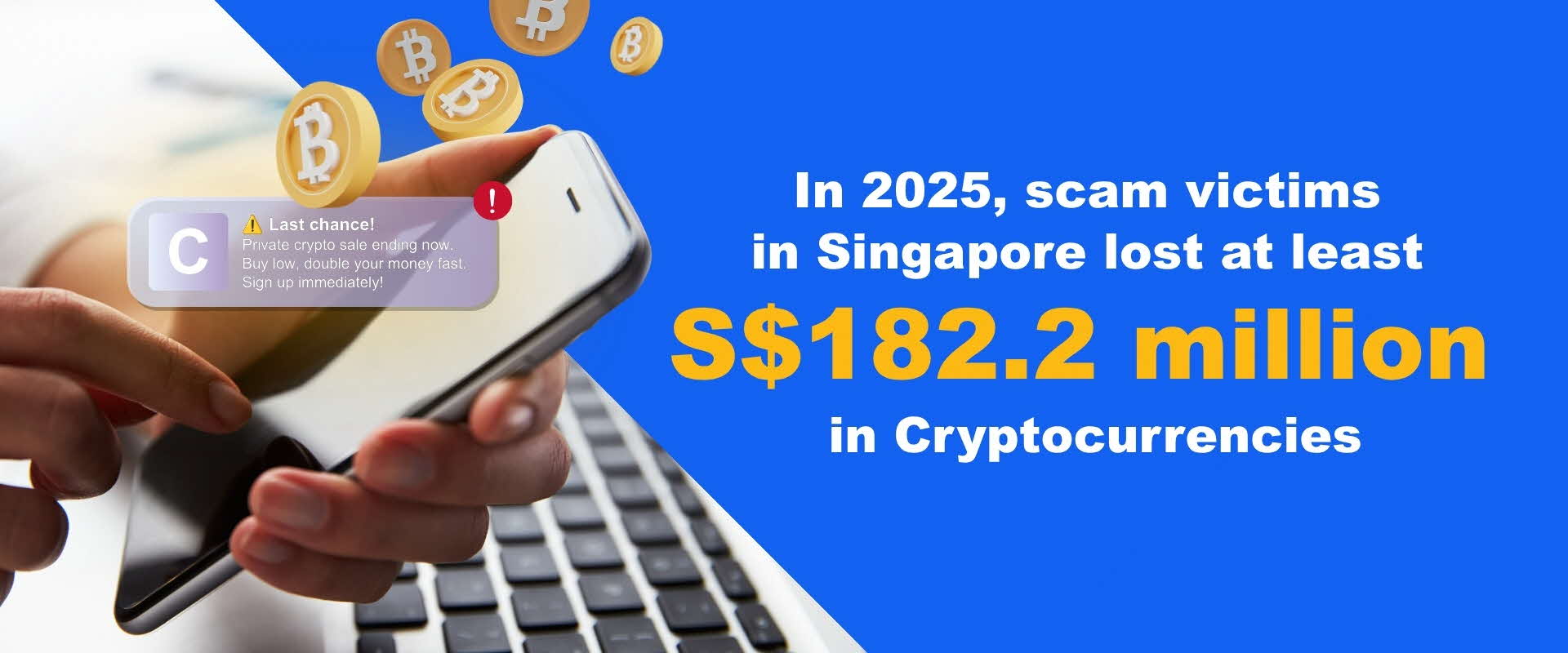
Cryptocurrency-related scams resulted in S$182.2M losses in Singapore in 2025, making up 20% of all reported fraudulent financial losses.
Last updated 28 May 2026
Key takeaways
Cryptocurrencies are not suitable for retail investors.
Cryptocurrency transfers are non-reversible.
Annual Scams and Cybercrime Brief 2025
This represents about 20% of all money lost to scams that year. Scammers leverage cryptocurrency because of its irreversible transactions. Cryptocurrency transactions are also difficult to trace, making it very hard for authorities to recover stolen funds.
Tether, Ethereum, and Bitcoin were the top cryptocurrencies that scam victims reported losing, which made up about 91.7% of total cryptocurrency scam losses. (More details can be found in table below.)
Top 5 Cryptocurrencies Lost to Scams in 2025
(Based on estimated value in Singapore dollars)
Cryptocurrency | Cryptocurrency units lost | Estimated value in Singapore dollars (approximate) |
|---|---|---|
Tether | 90,819,092.91 | $117.7M |
Ethereum | 6,785.20 | $26.1M |
Bitcoin | 176.16 | $23.2M |
How it works?
Most cryptocurrency related scams fall into three main types:
1. Government Officials Impersonation Scams (GOIS)
Scammers pretend to be government officials and falsely accuse victims of crimes such as money laundering. They would instruct victims to create cryptocurrency accounts and transfer their funds to designated wallets for "investigation" or “safeguarding”. Victims only discover the scam when they verify with official government agencies.
2. Investment Scam
In 2025, investment scams accounted for 38.4% of all cryptocurrency losses. Scammers would direct victims to create new cryptocurrency accounts for "investing". Victims are then asked to transfer their cryptocurrency to designated wallets or share their login details and seed phrases. This gives scammers full control over the victims' accounts.
3. Job scams
Victims would encounter cryptocurrency-related “job opportunities” through social media platforms such as Facebook, TikTok, and Instagram. Scammers would direct victims to buy cryptocurrency using their own money and claim they will earn "commissions" for helping to boost cryptocurrency values. Like other scam types, victims end up transferring their funds or sharing login details, giving scammers access to their accounts. Victims would realise that they had been scammed when they did not receive their “commissions” and their transferred funds back.
What protection do you have?
The Monetary Authority of Singapore (MAS) is working with cryptocurrency providers to strengthen anti-scam controls. Measures include stepping up fraud surveillance to detect mule accounts, and introducing friction and anti-scam warnings to safeguard victims from losses through their cryptocurrency accounts.
However, it is important to understand that MAS is unable to help with money losses through cryptocurrency investments or transactions, even if the cryptocurrency provider is an entity regulated by MAS.
Therefore, users of cryptocurrency platforms are strongly advised to exercise caution when engaging with cryptocurrency platforms and investments. MAS has cautioned that such investments are not suitable for retail investors, and users may risk losing all their funds.
How to stay safe?
Retail consumers should avoid cryptocurrencies due to their lack of fundamental value.
Users of cryptocurrency platforms must NEVER provide seed phrases, wallet passphrases, private keys or any authentication codes to any persons.
Be wary of fake websites or unsolicited chat groups promoting cryptocurrency investments with promises of high returns.
Additionally, you can ACT against scams:
Add the ScamShield app to block scam calls and filter scam messages.
Check for scam signs with official sources. You can check the legitimacy of suspicious messages, phone numbers and website links via the ScamShield app. Always verify that you are logged into the official website of your cryptocurrency platform before providing any 2FA or MFA access code.
Tell authorities, family, and friends about scams to help protect others.
Unsure if something is a scam? Check by calling the 24/7 ScamShield Helpline at 1799.
Encountered this scam? Here’s what to do
If you encounter such scams, you are advised to perform the following immediately:
Contact your cryptocurrency platform to halt further transactions or freeze your account.
Review and revoke any suspicious token approvals using applicable wallet interfaces.
If a wallet’s seed phrase is compromised, transfer all remaining cryptocurrencies in the compromised wallet to another wallet immediately.
Report any fraudulent cryptocurrency phishing websites to CSA’s SingCERT at singcert@csa.gov.sg or via the incident reporting form at https://www.csa.gov.sg/singcert/reporting.
Help keep the community safe by reporting any instances of this scam you’ve seen or experienced with the ScamShield App.